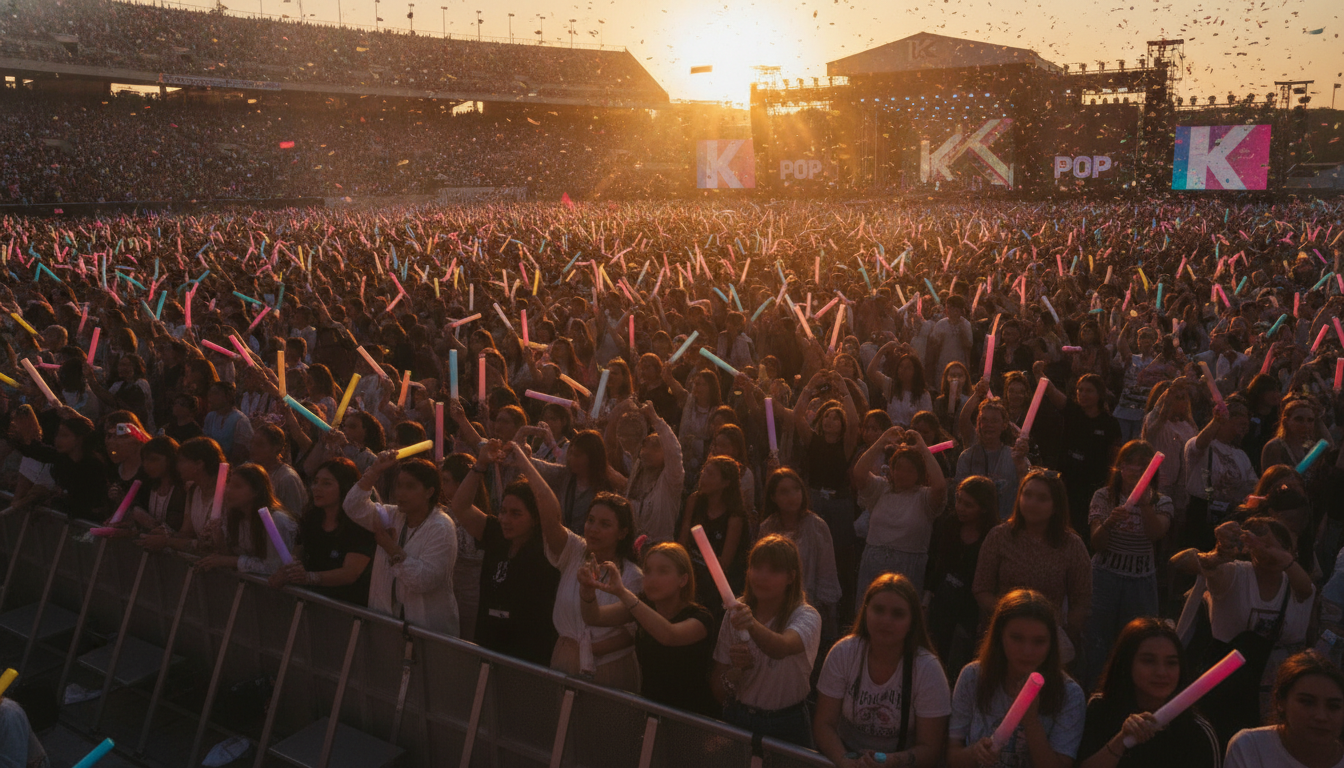
I was in a coffee shop in Philly last week, and I overheard two people who were clearly not K-pop fans talking about the soundtrack for K-Pop Demon Hunters. They were obsessed with “Golden” by Huntrix, debating if the group was real (we know the truth, of course!). It hit me then: the K-pop global impact we always talk about in 2026 isn’t just about Billboard charts or stadium tours anymore. It’s a seismic cultural force that’s quietly reshaping entire industries, from tourism and tech to even cosmetic surgery.
After attending over 50 concerts and fan signs since the 2nd generation, I’ve seen the Hallyu wave grow from a ripple to a tsunami. But what’s happening now is different. It’s deeper, more integrated. We’re not just consuming the music; the world is consuming the entire culture, and the economic ripple effect is staggering.
The ‘Demon Hunters’ Effect: When Fictional K-Pop Creates Real-World Hits
Honestly, has any piece of media had an impact like Netflix’s K-Pop Demon Hunters? We all binged it in 2025, but its influence is still peaking. TIME Magazine wasn’t exaggerating when they named it the “Breakthrough of the Year 2025.” A CNBC report from last November pointed out how the show was boosting not just Netflix subscriptions, but Korean music and even political soft power. It’s the perfect synergy machine.
The most insane part is the music. The show’s fictional girl group, Huntrix, has a legitimate smash hit with “Golden.” I nearly dropped my phone when I read that NVIDIA CEO Jensen Huang named it one of his favorite K-pop songs in an interview on June 8th. This isn’t just a fan streaming a song; this is a global tech leader amplifying a track from a fictional group. It proves the content is so compelling that the line between fiction and reality blurs. The Clemson News article from last August really nailed why: it found young people in Philadelphia felt the show’s K-pop culture “inspires innocence, joy and belonging.” That emotional connection is what gives it real-world power, turning a Netflix drama into a global cultural and economic engine. It’s a playbook we’re going to see copied for years to come.
Beyond the Music Video: The Hallyu Medical Boom
Okay, let’s talk about something a little more surprising. For years, we’ve seen fans try to emulate idol fashion and beauty routines. But now, it’s fueling a massive boom in Korean medical tourism. It’s a bit of a sensitive topic, but it’s impossible to ignore the numbers. A report from June 2nd of this year revealed that foreign spending on liposuction procedures at the 365mc clinic network doubled in 2025 compared to the previous year.
The report directly links this surge to the “global popularity of K-pop and K-beauty.” It’s a direct consequence of the idol aesthetic being broadcast globally 24/7 through music videos, Weverse lives, and Instagram. While we as fans appreciate idols for their talent and hard work, there’s no denying the visual standard they set is incredibly influential. This isn’t just about buying the same skincare anymore; it’s about people traveling across the world and investing thousands of dollars for procedures, creating a powerful new revenue stream for the Korean medical industry, all powered by the Hallyu wave. It’s a side of the K-pop global impact that we don’t often discuss, but the economic data is undeniable.
The Government is Finally All-In on the “BTS Effect”
For the longest time, it felt like the Korean government was playing catch-up, pleasantly surprised by K-pop’s success but not fully leveraging it. That has completely changed. According to a May 29th article, no president has taken tourism more seriously than President Lee, who took office back on May 4, 2025. His administration is betting big on using the Hallyu wave to drive regional tourism, moving beyond just Seoul.

This isn’t just a hunch on their part; it’s based on cold, hard data. Remember that analysis from last week? It estimated that BTS’s global fandom, our incredible ARMY, could alone boost Korea’s annual GDP by 0.1% to 0.5%. That is an absolutely mind-blowing number for a single music group. It’s the “BTS effect” quantified. The government sees this and understands that fostering K-culture isn’t just a matter of national pride; it’s a core component of their economic strategy. This means more funding, more global promotion, and more infrastructure for fans. When you see new tourism initiatives or cultural centers popping up, know that it’s part of this massive, top-down strategic push to capitalize on the global movement we’ve all helped build.
The Domestic Dilemma: Is Global Success Alienating Korean Fans?
Here’s the flip side, and we have to be real about it. As K-pop becomes more global, is it losing its “K”? I’ve seen this debate raging on forums, and an article in The Korea Herald last July asked the tough question: “Is K-pop’s global strategy backfiring?” It pointed out that as popularity soars abroad, domestic interest seems to be waning. I’ve felt this at times. Comebacks are often packed with English tracks, and promo cycles in the U.S. can be longer than in Korea.
Look at the new boy group 코르티스 (Cortis). Their album ‘GREENGREEN’ is a monster success—the news just yesterday said it’s one of the biggest K-pop albums released this year, second only to BTS’s monumental 5th studio album, “ARIRANG.” Their track ‘REDRED’ topped domestic charts like Melon and Bugs, which is amazing for a rookie. But the report also stressed their “뜨거운 인기” (fiery popularity) in Japan and the U.S. This is the new reality. Success is measured on a global scale from day one. This isn’t a bad thing, but it creates a tension. Statista data showed the incredible growth in K-pop popularity worldwide between 2014 and 2024, and that trend has only accelerated. The challenge for agencies in 2026 is balancing the massive international audience with the dedicated Korean fanbase that started it all. It’s a tightrope walk, and we’re seeing companies try to figure it out in real-time. On the bright side, the Korea JoongAng Daily noted on April 14th that K-pop’s massive spotlight is fueling growth for K-indie and other genres, so the overall Korean music scene is getting richer, which is a definite win.
Key Takeaways
K-Content is a Flywheel: Shows like K-Pop Demon Hunters are no longer just shows; they are multi-industry platforms that launch real music careers, influence tech leaders, and drive cultural conversations. The Economic Impact is Broader Than You Think: The Hallyu wave is directly fueling sectors like medical tourism, with verifiable data showing a massive increase in spending. Official Recognition is Here: The Korean government is now actively building economic policy around the “BTS effect” and K-culture’s global appeal, treating it as a major national asset. Global vs. Domestic is the Core Tension: The biggest challenge for K-pop in 2026 is managing its explosive international growth without leaving its loyal domestic fanbase behind.
The K-pop world is so much bigger than just the music now. It’s a fascinating, complex ecosystem that’s influencing global trends in ways we’re only just beginning to understand. And honestly? I can’t wait to see what it reshapes next.
Found this helpful? Bookmark us! ⭐